

Best Overall: Anker 733 Power Bank
Most Affordable: Anker PowerCore Slim 10 000
Best Mid-Range: INIU PD 22.5 W 20000 mAh
Best High-End: Anker Prime
What really matters when you shop a power bank
Choosing a portable battery looks simple until you weigh capacity, output, and real-world convenience. First, check a pack’s watt-hours (Wh). Airlines cap carry-ons at 100 Wh, so the legal limit is roughly 26 000–27 000 mAh at 3.7 V. Higher capacity means more full phone charges, yet it also means extra bulk and longer recharge times.
Next, focus on output speed. Modern phones and laptops thrive on USB-C Power Delivery. A bank that can push 45–65 W will fast-charge a MacBook Air or Steam Deck, while 100–140 W covers power-hungry 16-inch laptops. Look for PD 3.0 or 3.1 support, multiple USB-C ports, and features such as pass-through charging or a built-in AC plug.
Finally, consider durability and trust. Well-known brands submit packs for UL safety testing, add temperature and surge protection, and back the hardware with 18- to 24-month warranties. Spend where it counts, on reliable cells and smart power management, rather than on gimmicks you will never use.
Best Overall: Anker 733 Power Bank (GaNPrime PowerCore 65 W)
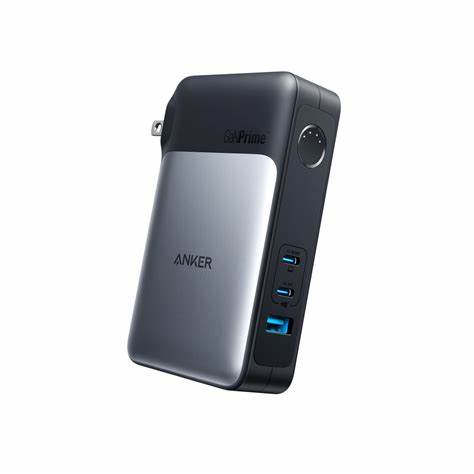
The 733 is a true two-fer, a 10 000 mAh battery fused to a 65 W GaN wall charger. Plug it into an outlet and it behaves like a fast laptop brick with two USB-C ports and one USB-A. Snap the prongs shut and you are carrying enough juice for about two full phone refills, plus the ability to top up a Chromebook. Its on-board display shows real-time wattage so you always know what is happening. Travel-ready, all-in-one convenience makes it the pack to beat.
The hybrid design does add girth (about the size of a chunky deck of cards) and the 733 tips the scales near 320 g. Even so, tossing one brick in your laptop sleeve beats juggling a charger, cables, and a separate battery. Frequent flyers also appreciate that the fixed AC plug means no forgotten charger heads in a hotel room.
Day-to-day use shows thoughtful details: PPS support for Samsung Super Fast Charging, PowerIQ load detection for older gadgets, and trickle mode for wearables. You trade sheer capacity for versatility, which is exactly why it earns the overall crown.
Pros
- 65 W USB-C output handles small laptops
- Integrated wall charger recharges itself in under 90 min
- Clear wattage display and three-device charging
Cons
- Heavier and thicker than plain 10 k packs
- Prongs make it pocket-unfriendly
Most Affordable: Anker PowerCore Slim 10 000
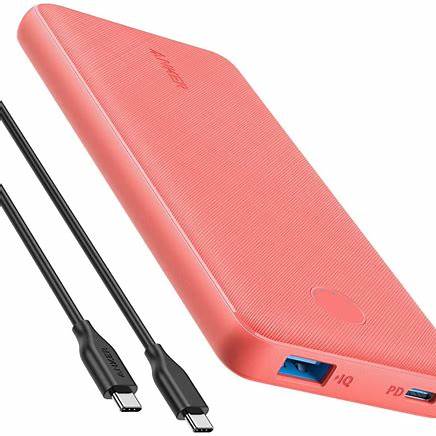
If you need reliable backup power without draining your wallet, the Slim 10 000 remains unbeaten. It costs about twenty-five dollars, slips into a jeans pocket, and still delivers two to three phone charges via its single USB-A output. Outdoor and tech testers consistently rate it the best budget buy thanks to Anker’s proven lithium-polymer cells, trickle mode for headphones, and rugged ABS shell.
Despite micro-USB input only, a full recharge still finishes overnight. The absence of USB-C output means it will not fast-charge tablets, but at this price point the priorities are value and longevity, areas where the Slim excels.
For campers, the bank’s surge protection and voltage-boost circuitry keep devices safe, and its slim profile sits flat against a phone when rubber-banded together in a pocket. You could buy two for less than half the price of many fancy 20 k packs and still have change for cables.
Pros
- Rock-bottom price for trusted brand quality
- Slim, grippy design fits small pockets
- Trickle-charge and surge-protection features
Cons
- USB-A only, no PD fast charging
- Micro-USB input feels dated
Best Mid-Range: INIU PD 22.5 W 20000 mAh
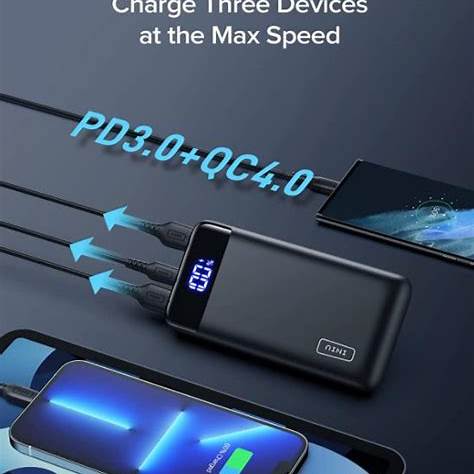
INIU hits a sweet spot with this 20 k pack: enough capacity for a weekend of phone and tablet charging, sub-$40 street price, and USB-C PD input/output up to 20 V × 1.25 A. Independent lab tests show excellent efficiency per gram, and a bright LED readout tells you the exact percentage remaining. Tech reviewers highlight its favorable watt-hours-to-weight ratio.
At 12 oz it is heavier than a 10 k pocket bank but noticeably lighter than many rival 20 k units. Dual Type-C ports plus a legacy USB-A let you charge three devices at once, and a built-in flashlight doubles as tent lighting. The shell meets basic drop-test standards, though it is not waterproof like some rugged models.
Performance testing shows about four full smartphone charges or one 13-inch laptop bump from 0 to 60 percent. Refill time is roughly six hours with a 30 W PD charger, and pass-through mode lets you recharge the pack while topping up gadgets. That balance of features and cost makes it the obvious mid-tier winner.
Pros
- 20 k capacity with 22.5 W PD for under $40
- Accurate digital display and flashlight
- Two USB-C ports for modern devices
Cons
- Bulky for everyday pocket carry
- Efficiency drops sharply below freezing
Top of the Line: Anker Prime 27,650 mAh 250 W
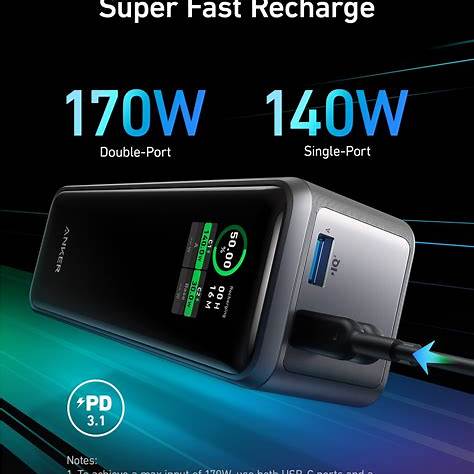
When money is no object and you crave desktop-class power on the go, the Prime takes the crown. Three ports share up to 250 W, with either USB-C jack capable of 140 W PD 3.1, enough to sustain a 16-inch MacBook Pro at full speed. A color LCD tracks per-port draw, battery temperature, and remaining run time. Tech outlets list it as the pick for power users in 2025.
Although the 99.5 Wh rating sneaks under TSA limits, its vertical “mini speaker” shape and 630 g mass mean it rides in a backpack, not a pocket. An optional charging base refuels the bank wirelessly at 100 W, handy for overnight desk setups.
In the field, Prime delivers roughly five smartphone refills while still carrying enough juice to rescue a gaming laptop or camera rig. Advanced cell balancing extends cycle life, and firmware updates arrive through a companion Bluetooth app, features rarely seen outside this price tier.
Pros
- 250 W total output, 140 W single-port charging
- Smart LCD plus Bluetooth monitoring
- Under airline limit despite huge capacity
Cons
- Expensive and heavy
- Overkill for phone-only users
Final thought
Whether you need a thrifty emergency charger or a beast that powers a workstation, 2025’s lineup has you covered. Match the pack to your devices, output needs, and carry style, and you will stay powered through flights, festivals, and everything in between workstation, 2025’s lineup has you covered. Match the pack to your devices, output needs, and carry style, and you will stay powered through flights, festivals, and everything in between.