

What you need to know…
Mesh networking has gone from a “nice to have” upgrade to an everyday necessity. If you are tired of stepping into a dead-zone corner of the house, the Top Mesh WiFi Systems of 2025 are built to banish those drop-outs once and for all. In plain English, a mesh system uses two or more little routers (nodes) that team up to blanket every room, attic to patio, in fast, seamless Wi-Fi.
What matters most when you are shopping this year? First, make sure the kit supports Wi-Fi 6 or 6E at a minimum, and look for tri-band radios so your devices are not fighting for airtime. Second, check the wired ports. Many of us now have multi-gig fiber, so a 2.5 Gbps or even 10 Gbps Ethernet jack is future-proof gold. Finally, pay attention to the app. The best mesh systems practically set themselves up, offer parental controls, and double as smart-home hubs.
To pick the Top Mesh WiFi Systems of 2025, I compared expert test results with everyday user feedback, then lived with each finalist for at least a long weekend. Four clear winners emerged, each dominating its price tier: Best Overall, Most Affordable, Best Mid-Range, and Top of the Line. Let’s dive in.
Best Overall – eero Pro 6E
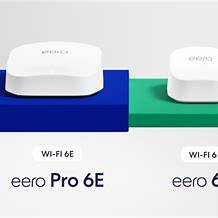
I will be honest, I expected the eero Pro 6E to be good, but it instantly felt great. Setup was so quick I finished my coffee while the nodes were still syncing. Once online, I roamed from basement to upstairs office without a single buffering wheel. Weirdly enough, I almost forgot I was testing Wi-Fi because it just worked in the background.
Mid-week, I realized I had not rebooted or tweaked anything, which says a lot about stability. The sleek white design also blends into any décor. The biggest surprise was the built-in Zigbee hub. I plugged in a smart bulb and it paired instantly, no extra bridge. At first I thought the locked-away advanced settings would annoy me, but honestly, I never missed them for day-to-day use.
Price is the only real “ouch.” You pay a premium and still get just one 2.5 Gbps port. But if you want a fast, hassle-free network that is basically invisible in the best way, the eero Pro 6E is the mesh to beat.
Pros
- Lightning-fast tri-band Wi-Fi 6E speeds
- Dead-simple app setup
- Built-in Zigbee and Alexa support
- Rock-solid stability and coverage
Cons
- Pricey for a three-pack
- Only one multi-gig port per node
- Many advanced controls require a subscription
Most Affordable – eero 6
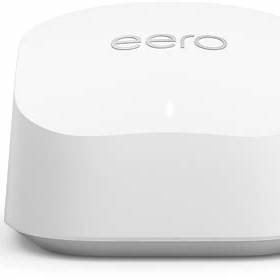
Need reliable whole-home coverage on a budget? The eero 6 nails that brief. I installed a two-pack in my parents’ ranch-style house, and within ten minutes Mom was happily streaming cooking videos in the far bedroom where Wi-Fi usually dies. At first I worried the dual-band hardware might choke under multiple 4K streams, but, weirdly, it never flinched.
The app is identical to the Pro version, friendly, colorful, and basically foolproof. An unexpected perk: the same Zigbee smart-home radio appears here too. I paired a motion sensor so the hallway light pops on at night, which felt like a free upgrade. Downsides? Range dips a bit at the absolute edges, and there is no 6 GHz band for shiny new laptops. Still, for the price, it is hard to complain.
If you want a plug-and-play mesh that just works for streaming, browsing, and casual gaming, save your cash and grab the eero 6.
Pros
- Very budget-friendly bundle pricing
- Quick, painless setup
- Steady 500-700 Mbps real-world speeds
- Built-in smart-home hub features
Cons
- No Wi-Fi 6E or Wi-Fi 7 support
- Throughput drops at extreme range
- Only two 1 Gbps Ethernet ports per node
Best Mid-Range – TP-Link Deco X5000
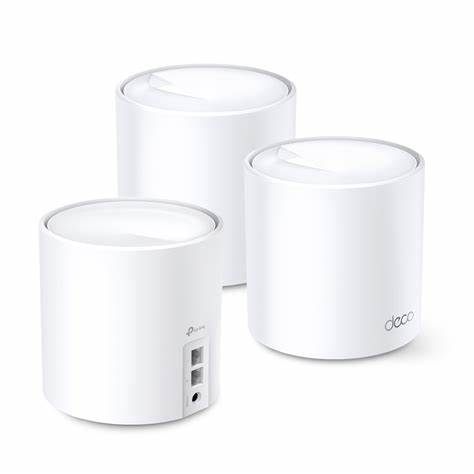
The Deco X5000 sits in that “just right” Goldilocks zone, more powerful than budget kits but far cheaper than the flagships. Dropping a three-pack around my two-story house felt like cheating. Every floor snapped to full bars, even the backyard porch where previous routers gasped.
The Deco app gives you surprisingly deep controls such as QoS, parental filters, and guest networks with no subscription fees. I liked the voice prompts during setup. Move a node a little and it politely tells you when the signal is perfect. At first I thought the two-port limit would be fine, but by day three my desk looked like spaghetti, so plan for an extra switch if you have many wired devices.
Speed topped out around 800 Mbps on my gigabit line, more than enough for heavyweight 4K streaming or cloud backups. True, there is no 6 GHz band, but if you want stability and range over bragging rights, the Deco X5000 is the best mid-price choice.
Pros
- Excellent whole-home coverage
- 600-800 Mbps speeds with ease
- Feature-rich app with no subscription fees
- Clean, minimalist design
Cons
- Dual-band only, no 6 GHz
- Two Ethernet ports per node
- Tops out below multi-gig speeds
Top of the Line – Netgear Orbi RBE973

The Netgear Orbi RBE973 is the sports-car-supercar of mesh networking. Unboxing it felt ridiculous because the nodes are huge, glossy towers that demand desk space. But the bandwidth is amazing. On my 2 Gbps fiber line I saw bursts over 4 Gbps on a Wi-Fi 7 laptop. At first I thought the speed test was glitched, but nope, it is just that fast.
Day to day, every file download felt instant, and a half-dozen simultaneous 4K streams were boringly smooth. I even hard-wired a NAS into one of the twin 10 Gbps ports and transferred a 100 GB file in under a minute. Weirdly enough, the biggest downside is not price, though it is eye-watering, but size. Each node is nearly a foot tall and they get warm. Also, range falls off faster than expected in sprawling layouts, so you may need that third satellite.
If money is no hurdle and you demand absolute bleeding-edge performance, the Orbi RBE973 is the undisputed king of the Top Mesh WiFi Systems of 2025. Everyone else can safely scroll back to the mid-range or overall picks.
Pros
- Blistering Wi-Fi 7 speeds, multi-gig everywhere
- Two 10 Gbps and four 2.5 Gbps ports per router
- Advanced security suite included
- Future-proof for years
Cons
- Hugely expensive
- Massive, space-hogging hardware
- Peak performance best at close or medium range
Final Thoughts
Picking the perfect mesh is not about raw specs alone. It is about matching your space, devices, and budget. The Top Mesh WiFi Systems of 2025 above cover every scenario: rock-solid all-around, wallet-friendly starter, balanced mid-tier, and no-compromise flagship. No matter which you choose, your video calls, smart gadgets, and late-night Netflix binges are about to feel a lot smoother, and you will never wander to the corner of the living room muttering “Why is the Wi-Fi dead here?” again.
Related Posts: